
When building a vintage village in Minecraft, the right layout can turn your settlement from “just another collection of houses” into a cohesive, elegant world. Instead of random buildings, think of meaningful pathways, volumetric spaces, an old-heritage charm, and premium detailing. The goal here: vintage, beautiful, luxurious—yet still playable and realistic in Minecraft. According to design discussions, villages benefit from thoughtful zoning, distinct styles, and decorative touches which elevate them beyond the default generation. Minecraft Forum+1
Below are ten curated layout ideas that you can tailor to your own terrain and aesthetic, each with one key focus to make it stand out.
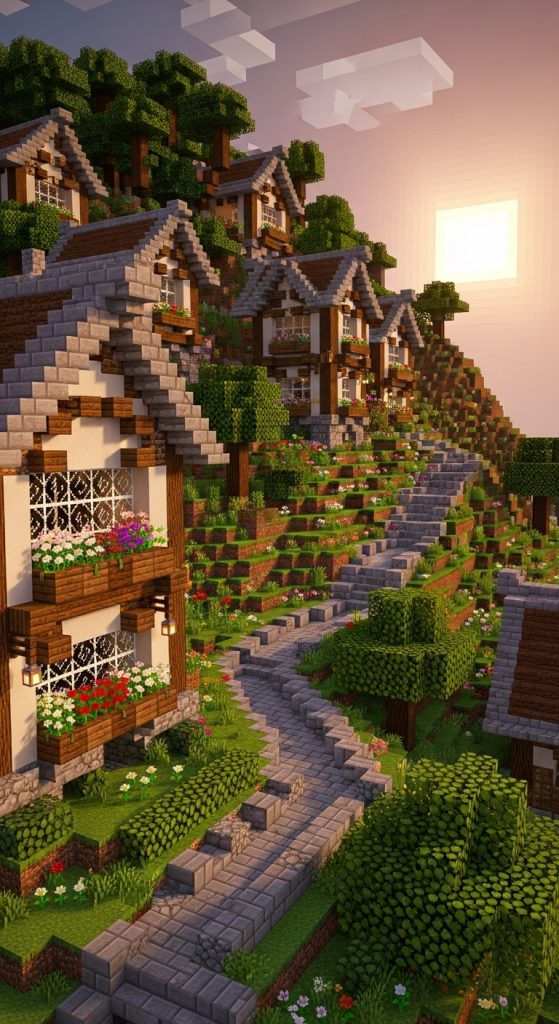
1. Terrace Hill-Village with Winding Cobblestone Paths
Imagine a village built up a gentle hillside, with homes terraced at different elevations, linked by elegant cobblestone walkways.
Key features:
- A central elevated plaza or fountain at the top of the hill, giving a vista of the village below.
- Curving, irregular cobblestone paths that feel historic and purposeful (avoid straight gridlines).
- Homes with stone foundations, timber accents, and flower boxes for a vintage feel.
- Perhaps a vineyard or small orchard on one of the lower terraces, adding richness.
Why this works: The elevation gives architectural drama; the winding paths create discovery and elegance; the terraced layout lets you incorporate nature (trees, vines, shrubs) into the village.
Gameplay tip: When choosing the hillside, pick a slope that’s moderate — steepness makes building harder but too flat loses the hillside charm.
2. Lakeside Manor Village with Jetty and Reflections
This layout focuses on a vintage lakeshore village, featuring elegant mansions or large homes on one side, and small craftsman cottages facing the water.
Key features:
- A large calm lake with a stone-and-wood jetty or boardwalk stretching out into the water.
- Mansions on the lakefront with pillared verandas, wide windows, and lantern lighting.
- Cottages in the rear, oriented towards the lake.
- Decorative willows or hanging vine trees by the water’s edge for a luxurious old-world feel.
Why this works: Water always adds elegance and reflection; the contrast between grand homes and smaller cottages builds visual hierarchy; the boardwalk adds a classy communal touch.
Gameplay tip: Use materials like polished andesite or stone bricks for the jetty edge, and mix oak/ dark oak for wood accents to keep it feeling premium.

3. Walled Vintage Town Square with Central Clock Tower
Here we build a compact vintage town surrounded by a stone-wall, with the heart of the town being a grand town square dominated by a clock (or bell) tower.
Key features:
- A circular or octagonal town square paved in smooth stone slabs, with benches, lamps, and a central fountain.
- A towering clock tower at one edge as a landmark — elegant yet vintage.
- Buildings around the square all facing inward, with shops on the ground floor and residential above.
- A vintage wrought-iron gate in the surrounding town wall, giving exclusivity.
Why this works: The enclosed wall gives a sense of heritage and purpose; the square gives focus and grandeur; the clock tower becomes the visual anchor.
Gameplay tip: Use stone brick walls with mossy variants to age the wall, and incorporate iron bars or fences for vintage lamp posts.


4. Forest Glade Hamlet with Rustic Wood-Stone Homes
For something more intimate and cozy: a vintage hamlet tucked into a forest glade, where nature and architecture merge elegantly.
Key features:
- Homes made from dark oak timbers and mossy cobblestone, with sloped roofs and dormer windows.
- Paths of coarse dirt and gravel, lined with ferns, mushrooms, and small shrubs.
- A central communal fire-pit or hearth building (a gathering space).
- The forest extends right up to the edges of the settlement, so the village feels embedded in nature.
Why this works: The contrast of rustic architecture with lush forest gives a luxurious escape-vibe; the small scale makes it feel exclusive and handcrafted.
Gameplay tip: Add lanterns hanging from fence-posts for atmospheric night lighting; keep the spacing between buildings more organic (not fixed grid).

5. Classic English-Vintage Countryside Village Layout
Inspired by the rolling countryside of old English villages, this layout uses narrow lanes, cottages, a church, and a village green.
Key features:
- A village green or triangular common in the centre, with a few benches and a small pond maybe.
- Narrow winding lanes of gravel or packed dirt, lined with hedges and flower beds.
- Cottages built with white-washed walls (use white terracotta or quartz) and dark wooden beams.
- A modest stone church with a spire at one end of the village.
Why this works: The countryside aesthetic brings timeless elegance; the winding lanes and hedges soften the layout; the church gives architectural focal-point.
Gameplay tip: Use stripped oak logs for the beams of the cottages, and plant alternating hedge blocks (leaves + bushes) along the lanes for greenery.

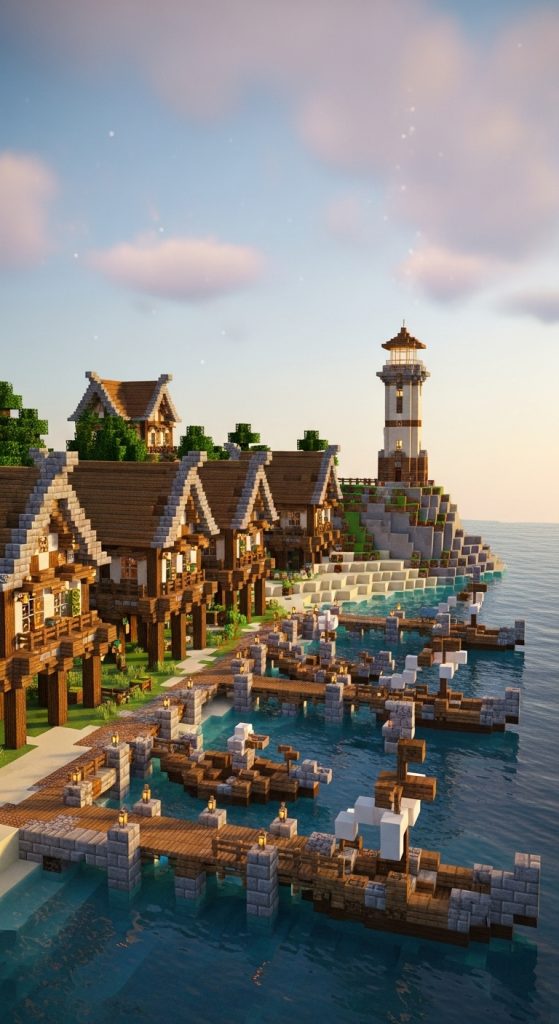
6. Vintage Coastal Fishing Village with Harbour and Lighthouses
Take the vintage vibe to the seaside: build a village facing the ocean with a harbour full of small boats, and a classic lighthouse on a rocky promontory.
Key features:
- Wooden piers and docks extending into the water, with moored small boats or rafts.
- The village homes sit on stilts or have wooden decks facing the water.
- A lighthouse made of stone and white-washed brick, rising on a rock formation.
- Sea-facing tavern or inn that doubles as a gathering spot.
Why this works: Water + docks + lighthouse = instant nostalgia and premium feel; the stilt homes add vintage authenticity; the harbour gives variety in layout.
Gameplay tip: Use spruce or dark oak for the stilt supports; mix stone brick and white concrete for the lighthouse for clean contrast.

7. Desert Oasis Vintage Settlement with Palm Trees and Sandstone Buffers
A less obvious vintage layout: a desert-edge villa-village built around a shimmering oasis, using sandstone, palm trees (jungle saplings), and shade structures.
Key features:
- An oasis pool in the centre, surrounded by sandstone paving and benches.
- Buildings built of smooth sandstone, cut sandstone, and dark wooden accents.
- Palm-tree groves (use jungle leaves + logs) casting shadows.
- Covered walkways and shaded market stalls along one side.
Why this works: The warm tones of sandstone feel luxurious; the oasis gives a refreshing centre; the palm trees and shade create resort-village vibes.
Gameplay tip: Place water blocks subtly under sand to create spring-like pool; add lanterns or glowstone recessed under sandstone arches for evening lighting.


8. Alpine Vintage Mountain Village with Sloped Roofs and Stone Plinths
Imagine a snow-capped or mountain-side vintage village: homes perched on stone plinths, steep roofs to handle snowfall, narrow winding stairs and terraces.
Key features:
- Houses on raised stone platforms (plinths) to handle steep terrain.
- Steep, dark-wood roofs (use dark oak or spruce stairs) with overhangs and chimneys.
- Central town hall or lodge with a large fireplace and panoramic windows.
- Terraces with pine trees, snow-covered ground (or the snow biome).
Why this works: Mountain villages feel exclusive and high-end; steep roofs and stone bases add vintage character; terraces and stairs add depth.
Gameplay tip: Use stone brick for plinths, granite or andesite accents for natural rock feel; inside the lodge use fireplaces built with netherrack + campfire + flue.
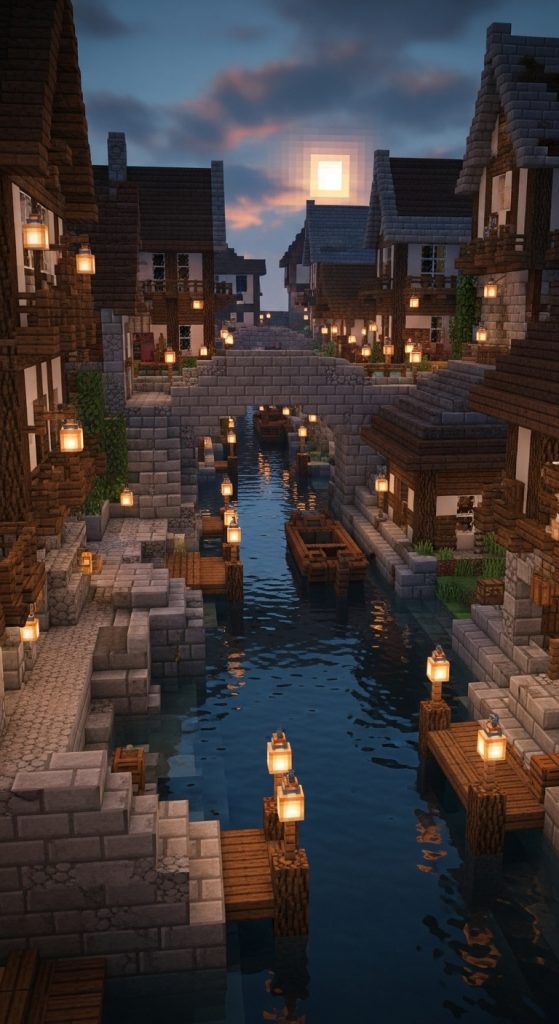
9. Winding Medieval-Vintage Canal Village with Boats and Bridges
Take a slightly different angle: a vintage village built around a canal network, with narrow homes fronting the water, arched stone bridges, and boats as part of the design.
Key features:
- A network of narrow canals (1–2 blocks wide) weaving through the village.
- Homes aligned along the canals with small private docks or steps down to the water.
- Arched stone bridges crossing the canal at several points.
- A central boathouse or water-mill building adding vintage charm.
Why this works: Water features always elevate design; the canal layout adds movement and variation; bridges and boats give charming touches.
Gameplay tip: Use stone brick arches for bridges, iron fences as railings; add boat dock posts (fence + chain + lantern) for detail.
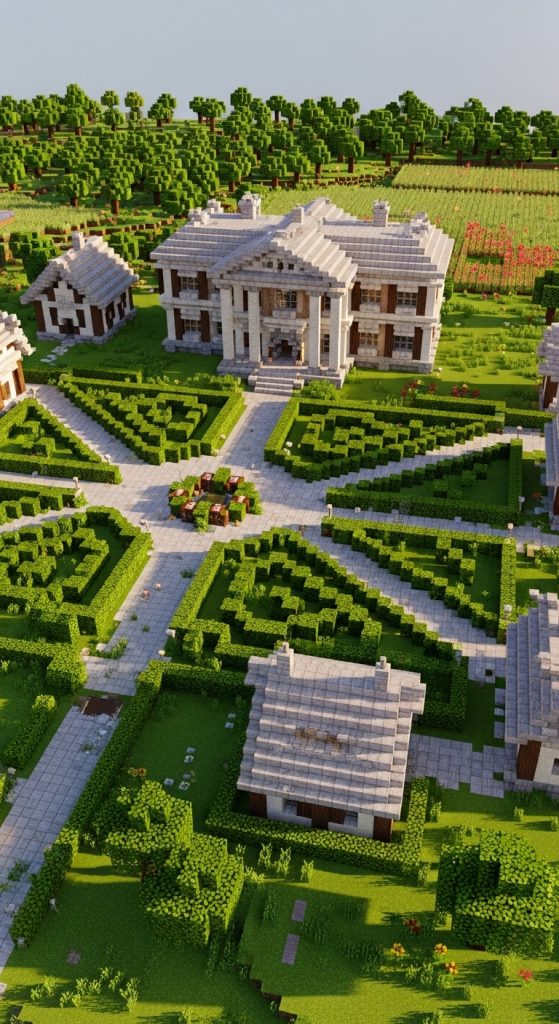
10. Vintage Farming Estate Village with Manor House and Worker Cottages
For a luxurious grand design: build a vintage estate style village, with a central manor house, symmetrically laid out worker cottages, formal gardens, and orchards.
Key features:
- Manor house in the centre: stone base, large windows, perhaps pillars or a grand entrance.
- Radiating paths from the manor to worker cottages arranged in symmetrical patterns (like spokes).
- Formal garden sections: hedges, fountains, rose bushes, trellis walkways.
- Fields and orchards further out: neat rows of crops, fruit trees, a barn or granary.
Why this works: The symmetry and formal gardens bring upscale “estate” feel; the arrangement gives coherence; worker cottages keep the village functional.
Gameplay tip: Use quartz columns or polished diorite for the manor’s accents; for the garden hedges use leaves blocks and path blocks like smooth stone slabs for walkways.

Implementation Tips & Aesthetic Bits
- Material palette: Pick 3-4 main materials (e.g., stone brick + dark oak + mossy cobblestone + spruce planks) and use them consistently for vintage feel.
- Path design: Avoid perfect grids. Winding or branching paths feel more historic and elegant. Use gravel, coarse dirt, stone slabs alternated.
- Lighting: For luxurious elegance, use lanterns, chains, hanging lights rather than basic torches. Place them along paths, next to doors, in trees.
- Vegetation and detail: Vintage villages aren’t sterile. Use vines, hanging lanterns in trees, flower boxes, bushes, and irregular features (e.g., a small broken wall) for realism and richness.
- Height variation: Whether you’re on flat land or slopes, vary building heights, add basements, terraced houses, small staircases. This adds depth and elegance.
- Landmark features: Each village should have one or two standout buildings (e.g., manor house, clock tower, lighthouse) so it feels curated rather than random.
- Functional spaces: Even if you’re mostly focused on aesthetics, incorporate functionality: farms, barns, docks, orchards—this gives the village life and purpose (gameplay value).
- Color and lighting themes: For a vintage feel, avoid overly bright neon blocks; go with muted, aged tones: mossy green, weathered stone, dark wood. At dusk/night, warm lighting adds ambience.


